

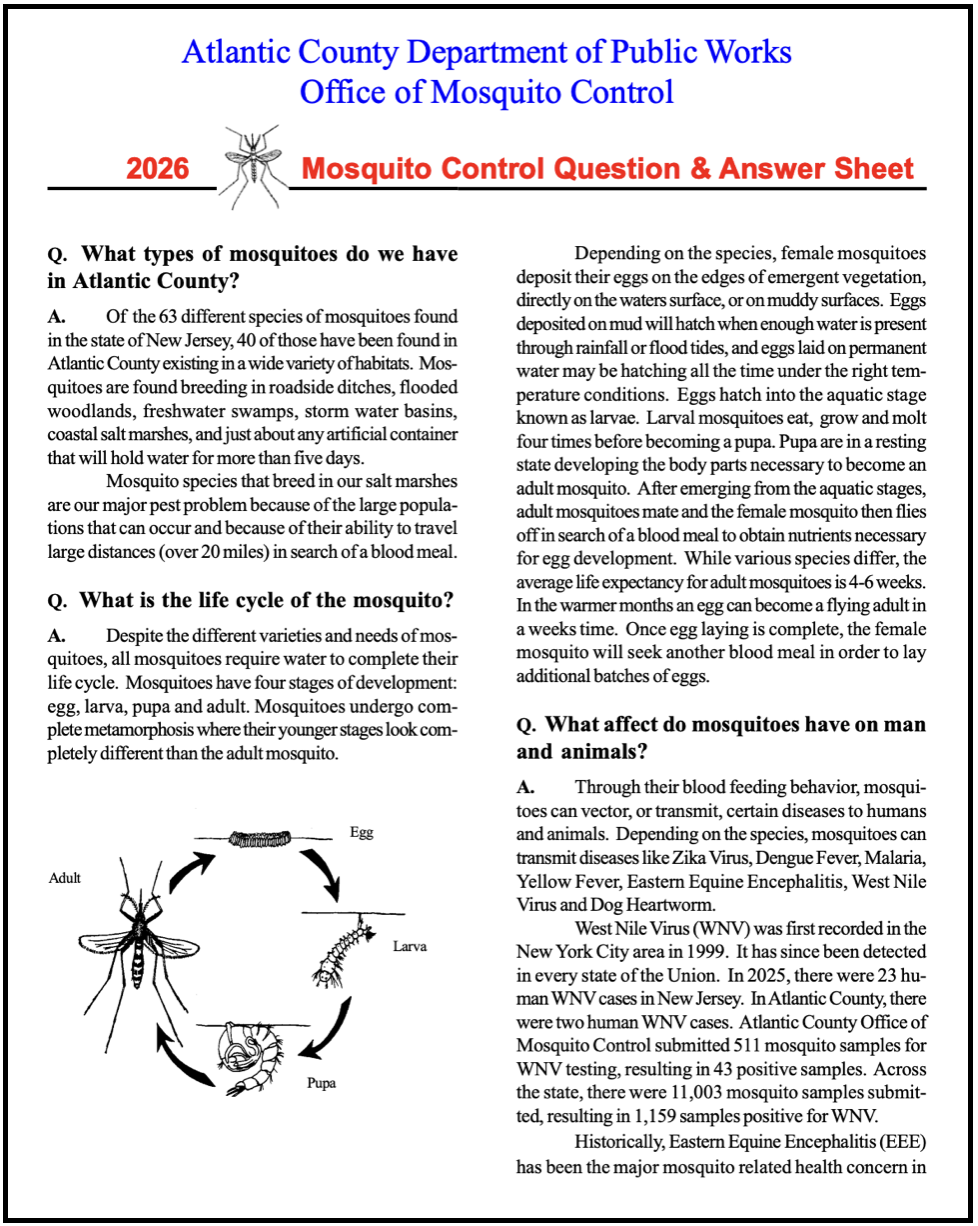
 2026 Atlantic County Department of Public Works Mosquito Q&A Sheet
Q. What types of mosquitoes do we have in Atlantic County?
A. Of the 63 different species of mosquitoes found in the state of New Jersey, 40 of those have been found in Atlantic Countyexisting in a wide variety of habitats. Mosquitoes are found breeding in roadside ditches, flooded woodlands, freshwater swamps, storm water basins, coastal salt marshes, and just about any artificial container that will hold water for more than five days. Mosquito species that breed in our salt marshes are our major pest problem because of the large populations that can occur and because of their ability to travel large distances (over 20 miles) in search of a blood meal.
• Click here to download the entire 2026 Mosquito Control Question & Answer Sheet.
Mosquito Control Fact Sheets
What is Zenivex™ E20 adulticide and how is it used?
Zenivex™ E20 is an insecticide product that is recommended for mosquito control in New Jersey by Rutgers, The State University of New Jersey. Zenivex™ E20 contains a pesticide called Etofenprox, a member of the category of pesticides called non-ester pyrethroids, which are synthetic versions of pesticides produced by plants called pyrethrins.
• Click here to download the entire Zenivex™ E20 fact sheet.
What is VectoPrime FG and how is it used?
VectoPrime FG is used to prevent mosquitoes from hatching in lakes, ponds, and other bodies of water. It acts on the larval or immature stage of the mosquito in water before the flying mosquito emerges.
• Click here to download the entire VectoPrime FG fact sheet.
 What is Natular® XRG and how is it used?
Natular® XRG contains parts of a naturally occurring soil bacterium. When mosquito larvae eat the spores, toxins are released by the mosquito’s stomach fluids, which in turn cause the larvae to die. Natular® XRG is part of a mosquito management approach using habitat management and other measures to control immature mosquitoes in order to lessen the need to spray for adult mosquitoes.
• Click here to download the entire Natular® XRG fact sheet.
What is BVA 2 Mosquito Larvicide Oil and how is it used?
Mineral oil is used to prevent mosquitoes from hatching in lakes, ponds and other bodies of water. It acts on the pupae or immature stage of the mosquito in water immediately before the flying mosquito emerges.
• Click here to download the entire BVA 2 Mosquito Larvicide Oil fact sheet.
What is Altosid and how is it used?
Methoprene is used to prevent mosquitoes from hatching in ponds, wetlands and other bodies of stagnant water. It acts on the larval or immature stage of the mosquito in water immediately before the flying mosquito emerges.
• Click here to download the entire Altosid fact sheet.
What is Merus 3.0™ adulticide and how is it used?
Merus 3.0™ is Organic Materials Review Institute (OMRI) listed and meets National Organic Program (NOP) standards for adult mosquito control in and around organic gardens, farms and crops. It poses a low risk to human health and the environment when used properly as part of an integrated mosquito control program.
• Click here to download the entire Merus 3.0™ fact sheet.
 What is Atrapa, Fyfanon and Microflo and how is it used?
Malathion is used for the control of adult mosquitoes. While habitat management and measures to control immature mosquitoes in water are the preferred routine approaches, the spraying of adult mosquitoes is called for when biting populations reach critical levels or when a disease organism is present in adult mosquitoes.
• Click here to download the entire Atrapa, Fyfanon and Microflo fact sheet.
What is Duet Dual-Action® adulticide and how is it used?
Duet Dual-Action® contains two pesticides called Prallethrin and Sumithrin, and a synergistic compound called piperonyl butoxide which increases the effectiveness of the pesticides. Prallethrin and Sumithrin are members of a category of pesticides called pyrethroids, which in turn are synthetic versions of pesticides produced by plants called pyrethrins.
• Click here to download the entire Duet Dual-Action® fact sheet.
What is Vectobac, Teknar, Bactimos, Aquabac and Mosquito Dunks and how is it used?
These products are recommended for mosquito control in New Jersey by Rutgers, The State University of New Jersey. They contain the pesticide called “Bacillus thuringiensis israelensis (B.t.i.).” The U.S. Environmental Protection Agency’s (EPA) current evaluation considers B.t.i.- containing products to be very slightly toxic with minimal potential risk to people when used properly as part of a complete mosquito control program.
 What is VectoLex® and how is it used?
VectoLex® is used to prevent mosquitoes from hatching in lakes, ponds, and other bodies of water. It acts on the larval or immature stage of the mosquito in water before the flying mosquito emerges.
• Click here to download the entire VectoLex® fact sheet.
What is eastern equine encephalitis (EEE)?
Eastern equine encephalitis (en-sef-AH-ly-tis) is a rare but serious viral infection. This disease is most common in the eastern half of the United States and is spread by the bite of an infected mosquito. EEE can affect humans, horses and some birds. The risk of getting EEE is highest from late July through early October.
• Click here to download the entire EEE fact sheet.
Atlantic County Office of Mosquito Control
To report a mosquito problem –> CLICK HERE <– or call the Atlantic County Office of Mosquito Control at 609-645-5948 during normal business hours. Visit atlanticcountynj.gov for additional resources.
Mosquito Control officials remind residents of the importance of removing standing water from their properties, cleaning their gutters to eliminate potential mosquito breeding grounds and cutting high grass around their yards.
Mosquito Links
- American Mosquito Control Association
- US EPA Mosquito Control
- US EPA and CDC Joint Statement on Mosquito Control
West Nile Virus Links
- Atlantic County Public Health West Nile Virus Information
- Center for Disease Control Q&A
- NJ Department of Agriculture West Nile Virus Information
- NJ DOH West Nile Virus
- USDA West Nile Species Profile
Ten Commandments of Mosquito Control
- Check your yard and eliminate all standing water in:
- Roof gutters and rain barrels
- Boats and birdbaths
- Cans, bottles, and plastic bags
- Flower pots and vases
- Unused swimming and wading pools
- Wheelbarrows and mortar tubs
- Ornamental pools and fountains
- Cellars and crawl spaces
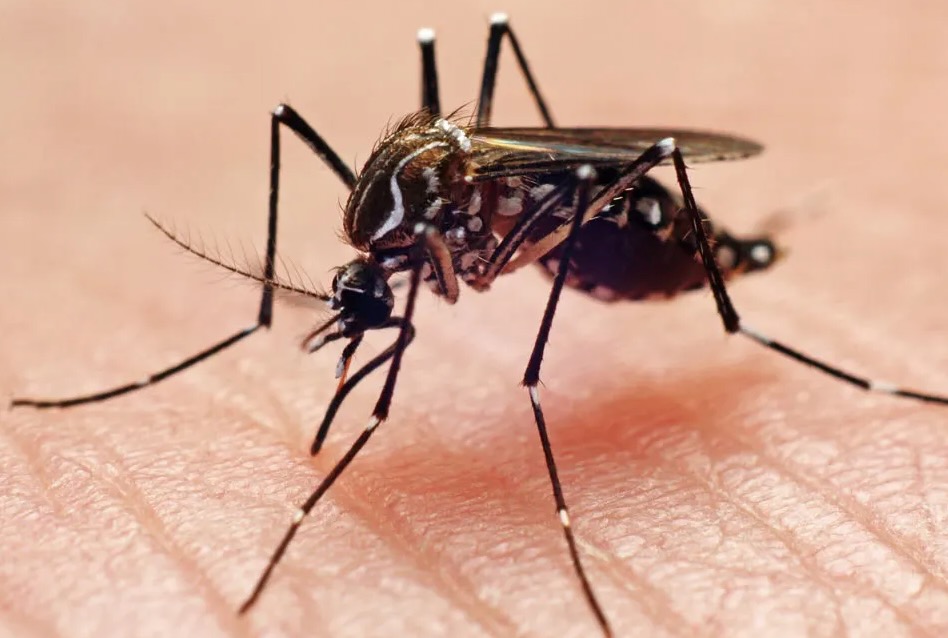
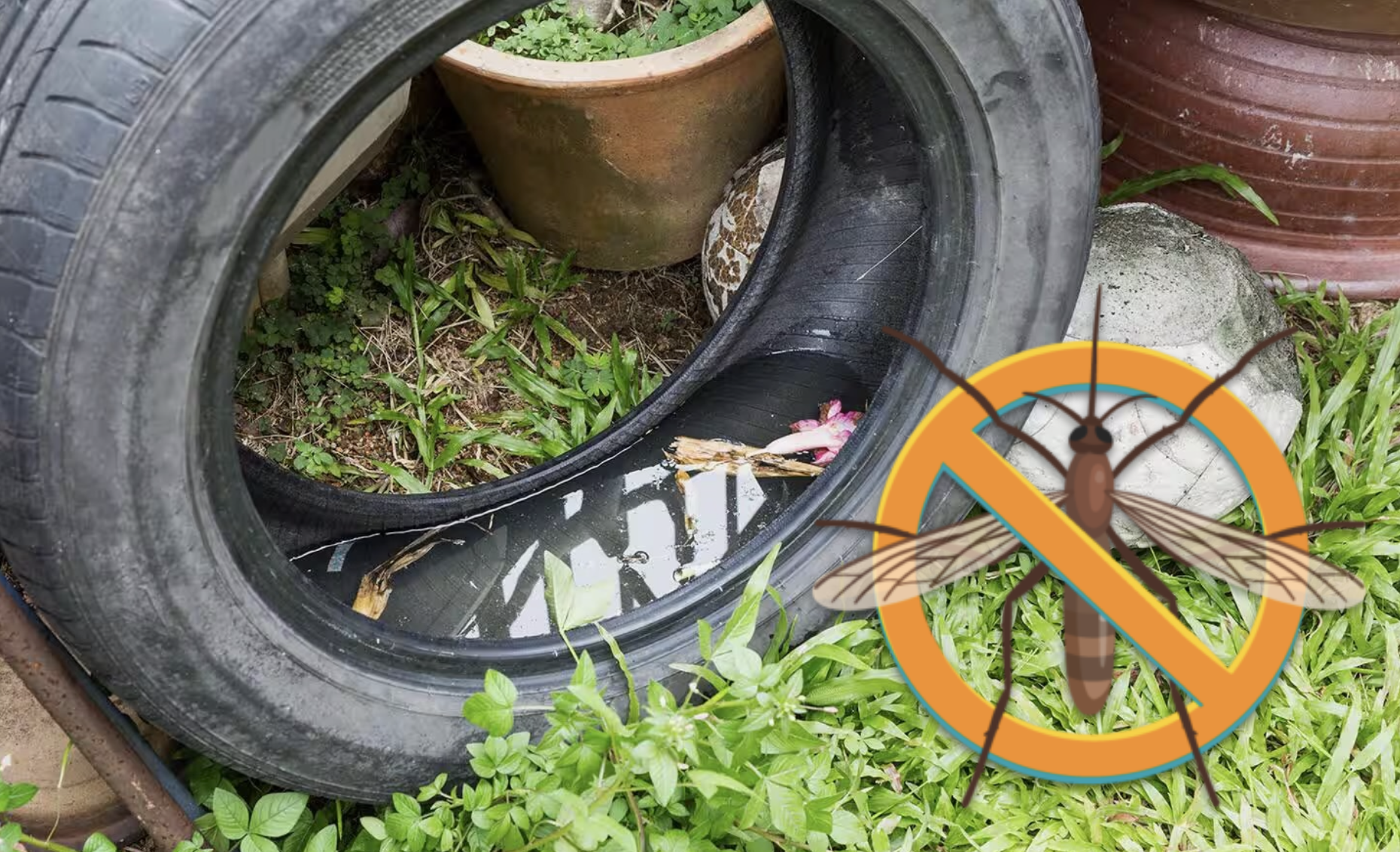
- Old tires and tire ruts.
- Flatten all types of open cans and containers or puncture holes in bottom
- Completely seal cesspools and screen all vents
- Clean clogged roof gutters and drain flat roofs so no water stays
- Cover all standing receptacles, such as rain barrels in rural areas with netting
New Jersey State Mosquito Control Commission
- NJDOH – Mosquito-borne Diseases Webpage: nj.gov/health/cd/topics/mosquitoborne.shtml
- NJDOH – Interactive Vector-Borne Disease Dashboard: dashboards.doh.nj.gov/views/public_dashboard/Intro
- NJDOH – Weekly Vector-Borne Surveillance Reports: nj.gov/health/cd/statistics/arboviral-stats
- NJDEP – Contact Mosquito Control Webpage: dep.nj.gov/njfw/contact-mosquito-control/#county
- New Jersey Department of Agriculture – Animal Health Webpage: nj.gov/agriculture/divisions/ah
For more information about mosquito control, contact:
c/o Office of Mosquito Control Coordination
Mail Code 501-03
P.O. Box 420
Trenton, NJ 08625-0420
Phone #: 609-292-3649
FAX #: 609-633-0650
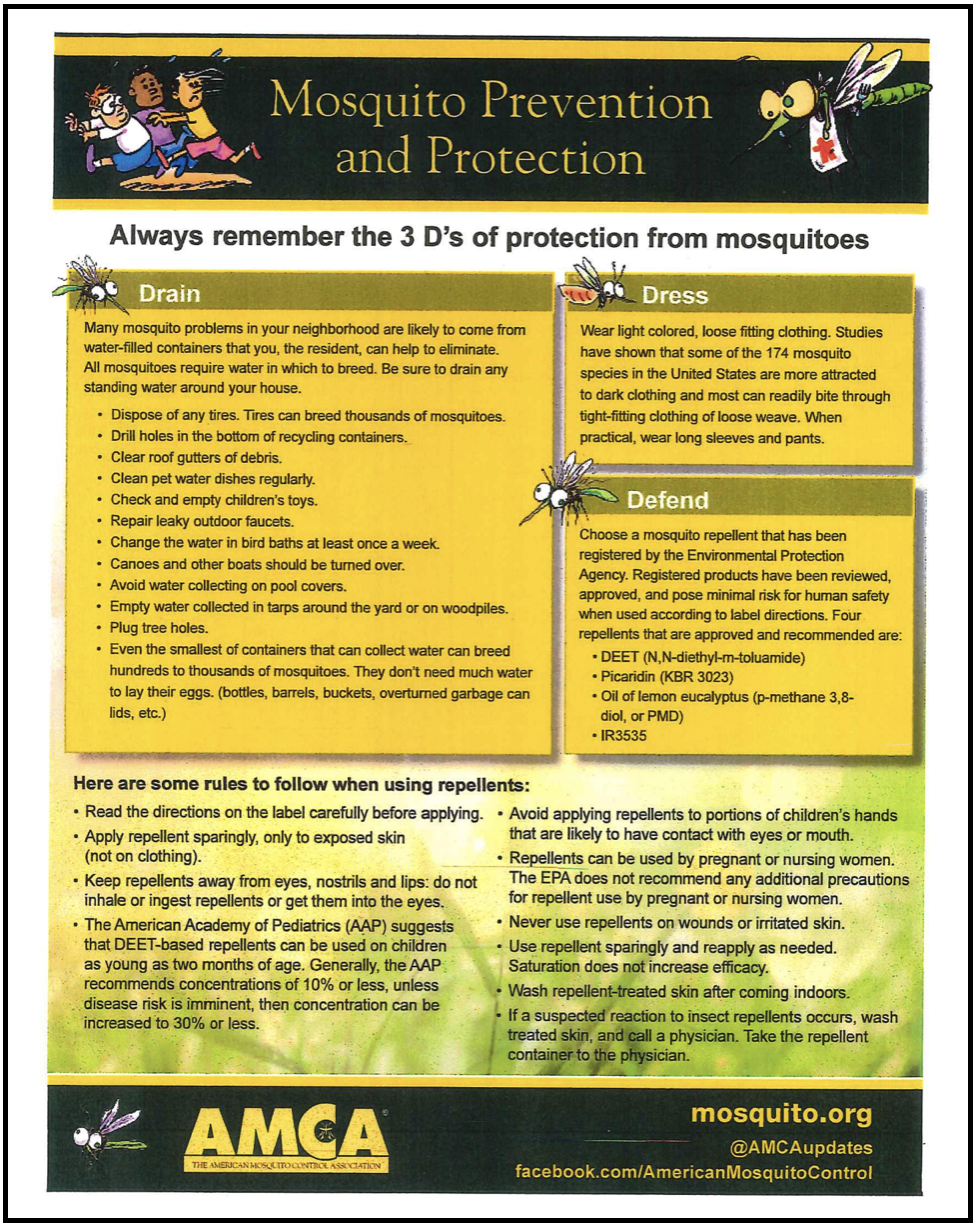
Download: Mosquito Prevention and Protection
Many mosquito problems in your neighborhood are likely to come from water-filled containers that you, the resident, can help to eliminate. All mosquitoes require water in which to breed. Be sure to drain any standing water around your house.
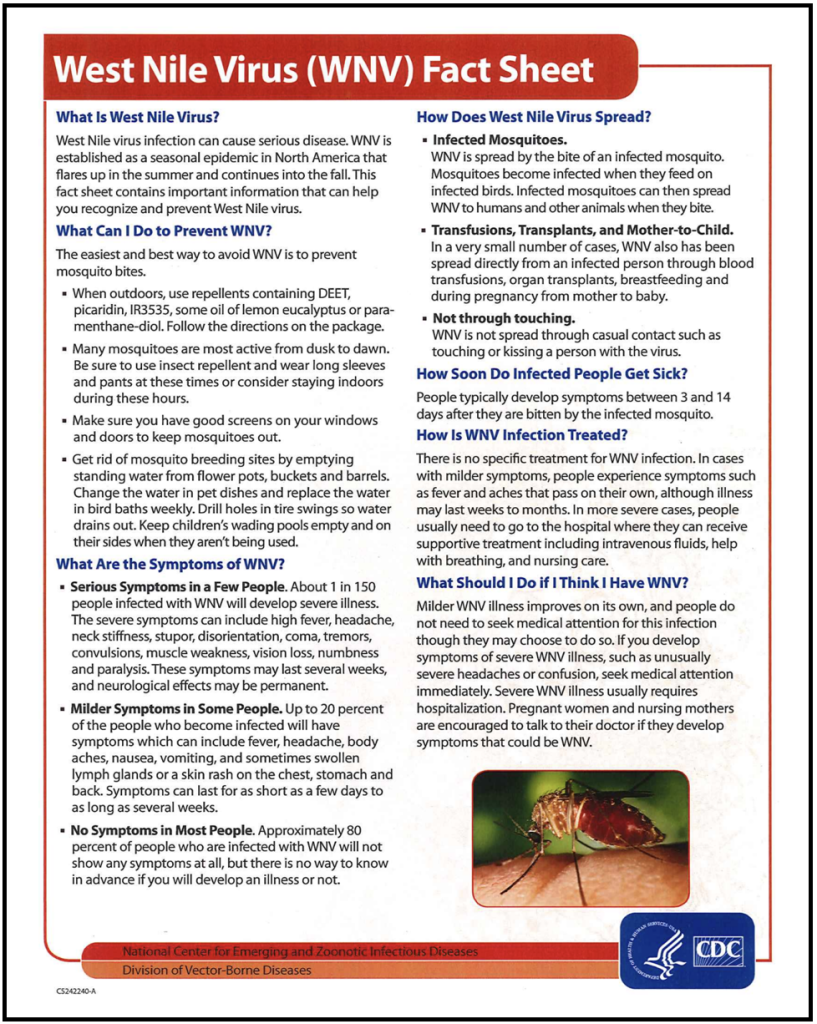
Download: West Nile Virus Fact Sheet
West Nile virus infection can cause serious disease. WNV is established as a seasonal epidemic in North America that flares up in the summer and continues into the fall. This fact sheet contains important information that can help you recognize and prevent West Nile virus.
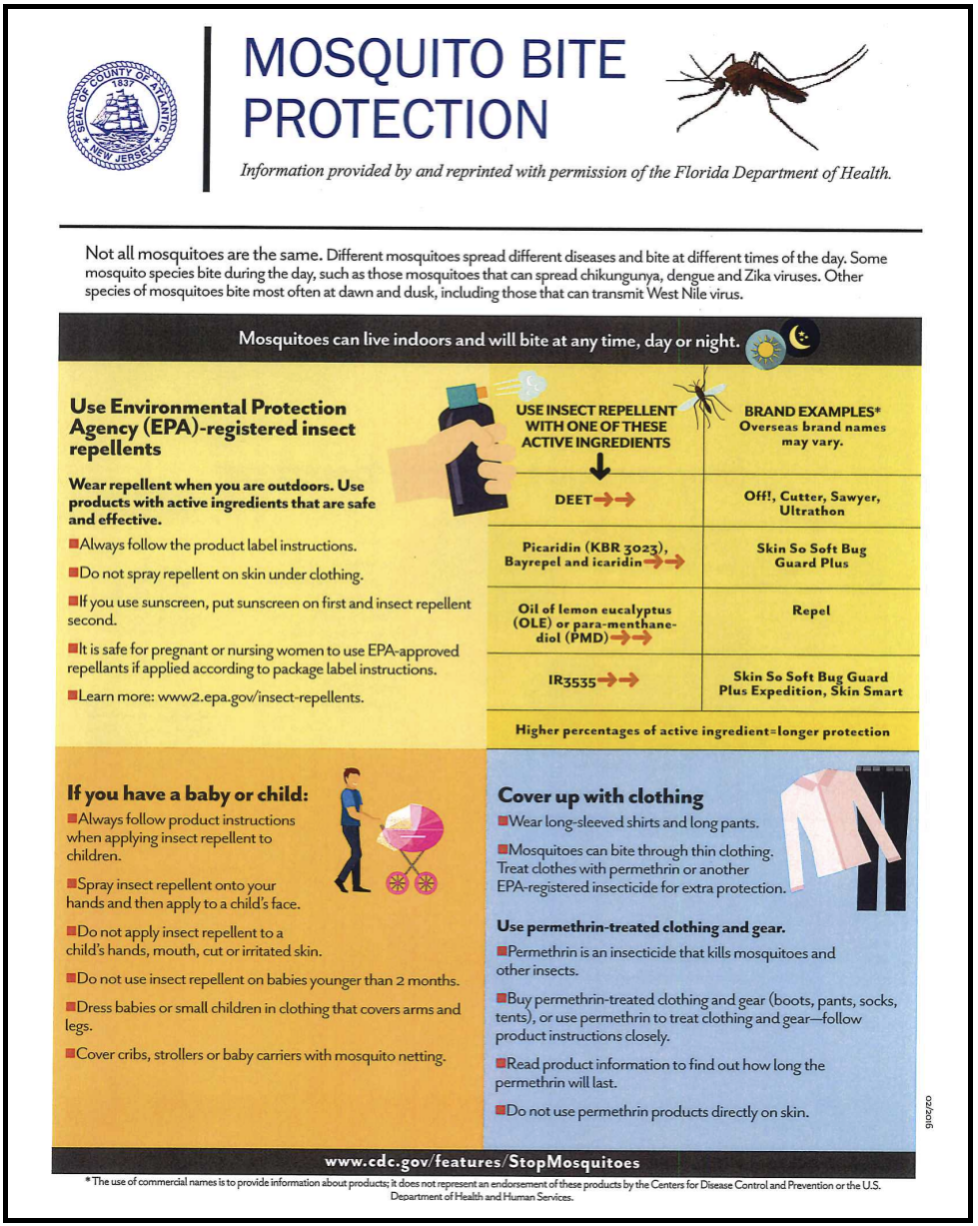
Download: Mosquito Bite Protection
Not all mosquitoes are the same. Different mosquitoes spread different diseasesand bite at different times ofthe day. Some mosquito species bite during the day,such as those mosquitoesthat can spread chikungunya, dengue and Zika viruses. Other species of mosquitoes bite most often at dawn and dusk, including those that can transmitWest Nile virus.
Hammonton Town Hall
Location: 100 Central Ave., Hammonton, NJ 08037
Phone: 609-567-4300
Hours: Monday through Friday 9:00 a.m. to 4:30 p.m.
