

Municipal Utilities • Phone: 609-567-4331
Email: adecicco@townofhammonton.org
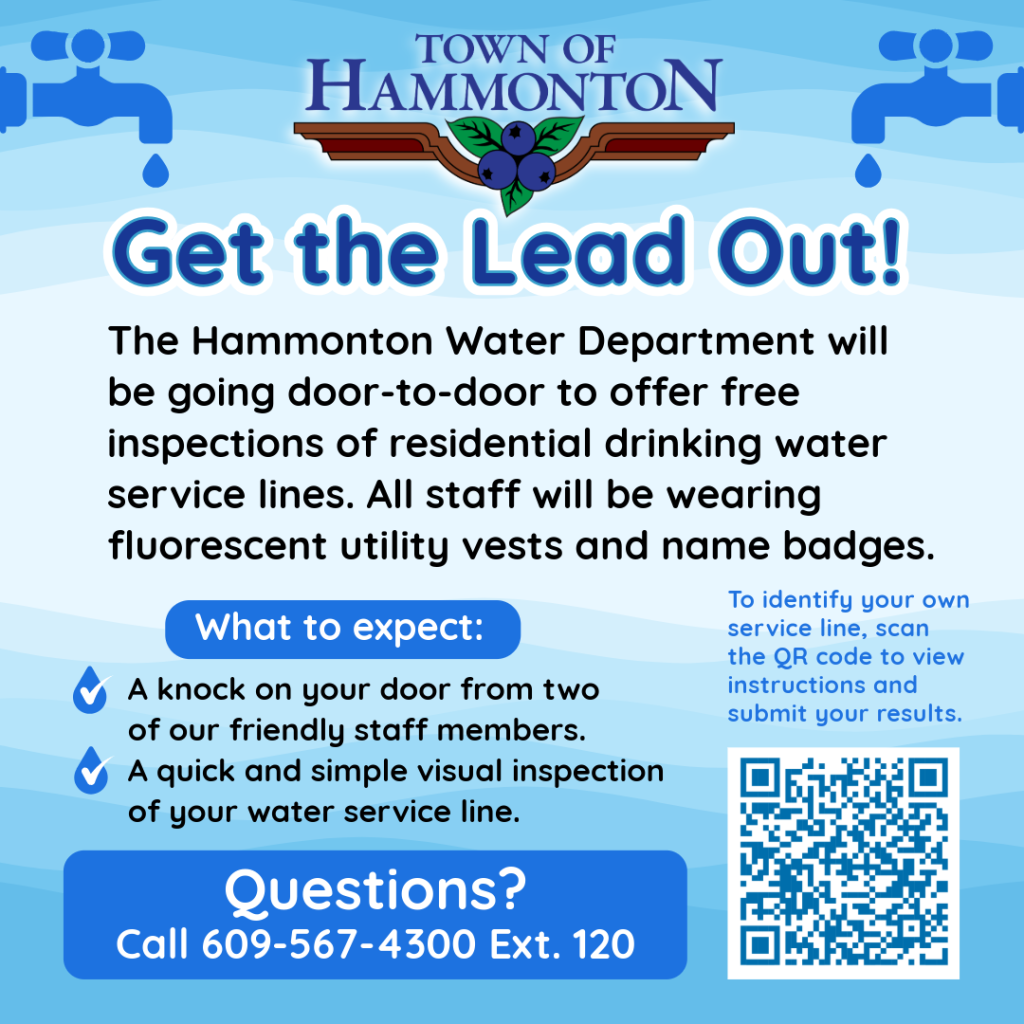 Hammonton Water Department to Provide Free In-Home Inspections of Water Service Lines
The Hammonton Water Department will be going door-to-door to offer free inspections of residential drinking water service lines to develop a more complete inventory of Hammonton Water Department’s water service line materials. Water service lines are the pipes that carry water from water mains in the street to the Town of Hammonton’s homes, schools, and other buildings. This is part of an ongoing effort to identify and replace water service lines in the system that are made of or could contain lead.
Inspections Will Help Identify and Develop a Plan to Replace Lead Service Lines
Lead is a naturally occurring metal that was used in some plumbing fixtures and water service lines before this practice was banned in the late 1980s. When clean drinking water passes through service lines made of or containing lead, the lead can be released into the water. Exposure to lead in drinking water can cause learning and behavioral problems in infants and children, including children of women exposed to lead before or during pregnancy. In adults, lead exposure can increase the risk of heart disease, high blood pressure, kidney disease, and nervous system problems. More information is available at NJDEP-Division of Water Supply & Geoscience and Basic Information about Lead in Drinking Water | US EPA.
The Town of Hammonton is required by state and federal law to inventory water service lines and replace service lines made of or containing lead. This includes galvanized steel lines that could have been downstream of a lead pipe at one time. The Hammonton Water Department completed an initial inventory of its water service line materials in October 2024. The door-to-door inspection effort will focus on identifying the materials of service lines currently listed in the inventory as “unknown.” The water service line inventory is available by clicking here or calling the Hammonton Water Department at (609) 567-4300 Ext. 120.
To help with the water service line inventory and lead service line replacement planning, the Hammonton Water Department has partnered with the U.S. Environmental Protection Agency (EPA) under EPA’s Get the Lead Out (GLO) Initiative. Through this initiative, Hammonton Water Department is receiving technical assistance from EPA contractors, including assistance with the service line inspection effort. To learn more about the GLO Initiative, please visit Get the Lead Out Initiative | US EPA.
Inspections Are Quick and Free and Are a Way Residents Can Contribute to a Lead-Free Town of Hammonton
Water service lines include a public section owned by the Town of Hammonton that runs from the water main to a shut-off valve near the property line, and a private section owned by the building owner that runs from the shut-off valve into the building. In-home inspections allow the water system to identify the material on the private side of the service line where it enters the building. From Tuesday, August 26 through Thursday, August 28, teams will visit homes where the private-side water service line material is unknown. Teams will consist of 2-4 people wearing fluorescent utility vests and “Get the Lead Out” badges with their names. All teams will be accompanied by a member of the Hammonton Water Department.
Teams will ask for permission from the residents to inspect their water service lines. If the resident agrees, team members will locate the water service line where it enters the house, which is usually in the basement, conducting a quick and simple visual inspection of the water service line. Inspections will be completed in less than 5 minutes and will not disrupt the water service. Information from the inspection will be used to update the Town of Hammonton’s official water service line inventory.
For questions or additional information, please contact the Hammonton Water Department at (609) 567-4300 Ext. 120.
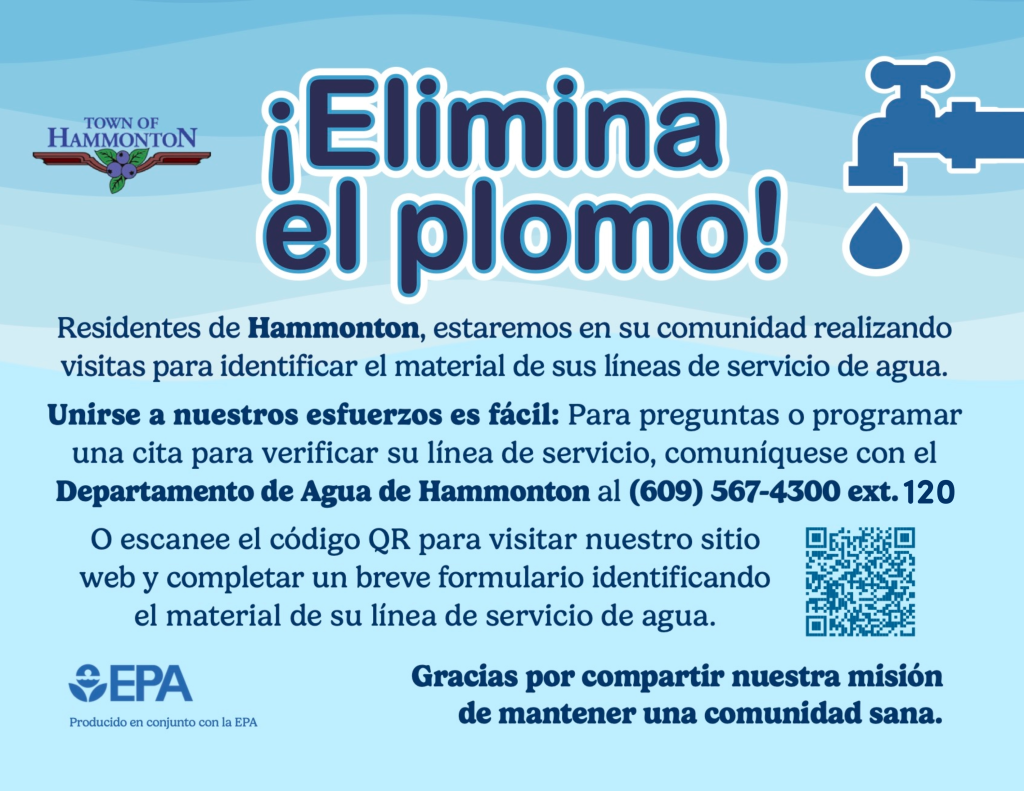 El Departamento de Agua de Hammonton proporcionará inspecciones gratuitas a domicilio de las líneas de servicio de agua del 26 al 28 de agosto
El Departamento de Agua de Hammonton realizará visitas a puerta-a-puerta para ofrecer inspecciones gratuitas de las líneas de servicio de agua potable residenciales con el fin de desarrollar un inventario más completo de los materiales de las líneas de servicio de agua del Departamento de Agua de Hammonton. Las líneas de servicio de agua son las tuberías que transportan el agua desde las líneas principales de la calle a los hogares, escuelas y otros edificios del Pueblo de Hammonton. Esto es parte de un esfuerzo continuo por identificar y reemplazar las líneas de servicio de agua en el sistema que están hechas de o podrían contener plomo.
Las inspecciones ayudarán a identificar y desarrollar un plan para reemplazar las líneas de servicio de plomo.
El plomo es un metal natural que se utilizaba en algunas instalaciones de plomería y líneas de servicio de agua antes de que esta práctica fuera prohibida a finales de la década de 1980. Cuando el agua potable limpia fluye a través de líneas de servicio hechas de plomo o que contienen plomo, este puede liberarse en el agua. La exposición al plomo en el agua potable puede causar problemas de aprendizaje y comportamiento en bebés y niños, incluido niños de mujeres expuestas al plomo antes o durante el embarazo. En adultos, la exposición al plomo puede aumentar el riesgo de enfermedades cardíacas, hipertensión arterial, enfermedades renales y problemas del sistema nervioso. Más información está disponible en NJDEP-Division of Water Supply & Geoscience (NJDEP- División de Suministro de Agua y Geociencias) e Información básica sobre el plomo en el agua potable | US EPA
El Pueblo de Hammonton está obligado por la ley estatal y federal a realizar un inventario de las líneas de servicios de agua y reemplazar las líneas de servicio hechas de o que contengan plomo. Esto incluye líneas de acero galvanizado que en algún momento estuvieron conectadas a una tubería de plomo. El Departamento de Agua de Hammonton completó un inventario inicial de los materiales de las líneas de servicio de agua en octubre de 2024. La inspección de puerta-a-puerta se centrará en identificar los materiales de las líneas de servicio que actualmente se encuentran en el inventario como “desconocido”. El inventario de líneas de servicio de agua está disponible en hacer clic aquí o llame al Departamento de Agua de Hammonton al (609) 567-4300 Ext. 120.
Para ayudar con el inventario de las líneas de servicio de agua y planificación del reemplazo de líneas de servicio de plomo, el Departamento de Agua de Hammonton se ha asociado con la Iniciativa Get the Lead Out (GLO) de la Agencia de Protección Ambiental de EE. UU. (EPA, por sus siglas en inglés). A través de esta iniciativa, el Departamento de Agua de Hammonton recibe asistencia técnica de contratistas de la EPA, incluyendo asistencia con el esfuerzo de inspección de líneas de servicio. Para obtener más información sobre la Iniciativa GLO, visite la página Get the Lead Out Initiative | US EPA (Iniciativa Eliminar el Plomo| EPA de EE. UU.).
Las inspecciones son rápidas y gratuitas y son una forma en que los residentes pueden contribuir a un Hammonton libre de plomo.
Líneas de servicio de agua incluyen una sección publica que es propiedad del Pueblo de Hammonton que se extiende de la tubería principal de agua a una válvula de cierre cerca de la línea de la propiedad, y una sección privada propiedad del propietario del edificio que corre desde la válvula de cierre hacia el edificio. Las inspecciones en el hogar permiten que el sistema de agua identifique el material en el lado privado de la línea de servicio donde entra al edificio. Desde el martes 26 de agosto hasta el jueves 28 de agosto, equipos visitarán hogares donde el material de la línea de servicio de agua del lado privado es desconocido. Los equipos estarán compuestos por 2-4 personas que usarán chalecos fluorescentes y tarjetas de identificación “Get the Lead Out” con sus nombres. Todos los equipos estarán acompañados por un miembro del Departamento de Agua de Hammonton.
Los equipos pedirán permiso a los residentes para inspeccionar sus líneas de servicio de agua. Si el residente acepta, miembros del equipo localizarán la línea de servicio de agua donde ingresa a la casa, que normalmente se encuentra en el sótano, y realizarán una inspección visual rápida y sencilla de la línea de servicio de agua. Las inspecciones se completarán en menos de 5 minutos y no interrumpirán el servicio de agua. La información de la inspección se utilizará para actualizar el inventario oficial de líneas de servicio de agua del Pueblo de Hammonton.
Para preguntas o información adicional, por favor contacte el Departamento de Agua de Hammonton al (609) 567-4300 Ext. 120.
Hammonton Water Department Lead Service Line Replacement Program
The Hammonton Water Department needs your help in creating an inventory of lead and galvanized water service lines. How can you help?
Fill out this ONLINE SURVEY to provide the Hammonton Municipal Utilities Department (HMUD) with your service line information or DOWNLOAD the paper survey and provide it to Kelly Vitalo in the Town Clerk’s Office by email: mruberton@townofhammonton.org or mail: Hammonton Town Hall, 3rd Floor, 100 Central Avenue, Hammonton, NJ 08037, Attn: Lead Service Line Replacement Program. If you are unsure of your service line, call 609-567-4300 ext. 120 to schedule an appointment for a Town representative to perform an in-person inspection. For more information: Lead Service Line FAQ for Consumers
Check Your Address and Verify Your Water Service Line Material
Click the link here: Hammonton Lead Service Line Inventory
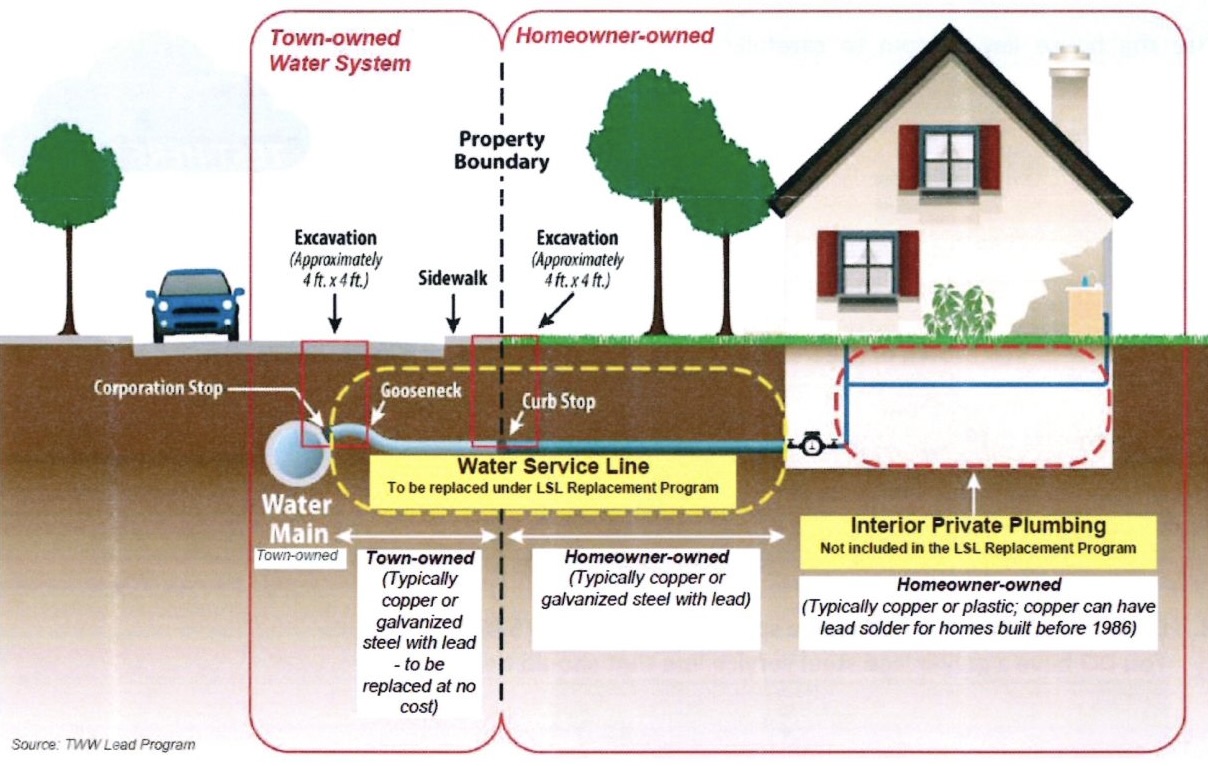 New Jersey recently passed a law requiring all public community water systems to inventory and replace all lead service lines within 10 years. This includes the entire service line, both the portion owned and maintained by the Town and the portion owned and maintained by the property owner (see diagram below).
The owner or operator (e.g., landlord) of a multi-unit dwelling (e.g., apartment building) must distribute this information to every resident. Delivery of a hard copy of the notice must be done by hand, or mail, and by posting the information in a conspicuous location in the common area of each dwelling.
EPAs’ Lead and Copper Rule Revisions and New Jersey’s Safe Drinking Water Act require all water systems to replace lead service lines in their service area by 2031. Under these regulations, the Hammonton Water Department is required to notify customers, non-paying consumers and any off-site owner of a property (e.g., landlord) when it is known they are served by a lead service line*.
 A service line is a portion of pipe that connects the water main to the building inlet (as seen in the figure below). Ownership of the service line varies by water system, but for Hammonton, the service line is owned partially by Hammonton and partially by the property owner. The service line materials on the water system side are not lead or galvanized and the service line materials on the property owner side are lead.
Hammonton is developing a lead service line replacement program. If you are planning to replace your lead service line, contact us at (609) 567-4300 ext. 102 prior to replacement so that we can coordinate our efforts.
*Note that per C.58:12A-41, section 2, the definition of a lead service line now includes lead connectors (lead gooseneck, lead pigtail or other lead fitting) and galvanized service lines
Health Effects of Lead
Lead can cause serious health problems if too much enters your body from drinking water or other sources. It can cause damage to the brain and kidneys and can interfere with the production of red blood cells that carry oxygen to all parts of your body. The greatest risk of lead exposure is to infants, young children, and pregnant women. Scientists have linked the effects of lead on the brain with lowered IQ in children. Adults with kidney problems and high blood pressure can be affected by low levels of lead more than healthy adults. Lead is stored in the bones, and it can be released later in life. During pregnancy, the child receives lead from the mother’s bones, which may affect brain development. Contact your local health department or healthcare provider to find out how you can get your child tested for lead if you are concerned about lead exposure. You can find out more about how to get your child tested and how to pay for it at: https://www.state.nj.us/health/childhoodlead/testing.shtml.
Sources of Lead in Drinking Water
Although most lead exposure occurs from inhaling dust or from contaminated soil, or when children eat paint chips, the U.S. Environmental Protection Agency (USEPA) estimates that 10 to 20 percent of human exposure to lead may come from lead in drinking water. Infants who consume mostly mixed formula can receive 40 percent to 60 percent of their exposure to lead from drinking water. Lead is rarely found in the source of your drinking water but enters tap water through corrosion, or wearing away, of materials containing lead in the water distribution system and household plumbing materials. These materials include lead-based solder used to join copper pipes, brass, and chrome-brass faucets, and in some cases, service lines made of or lined with lead.
New brass faucets, fittings, and valves, including those advertised as “lead-free”, may still contain a small percentage of lead, and contribute lead to drinking water. The law currently allows end-use brass fixtures, such as faucets, with up to 0.25 percent lead to be labeled as “lead free”. However, prior to January 4, 2014, “lead free” allowed up to 8 percent lead content of the wetted surfaces of plumbing products including those labeled National Sanitation Foundation (NSF) certified. Visit the NSF website at www.nsf.org to learn more about lead-containing plumbing fixtures. Consumers should be aware of this when choosing fixtures and take appropriate precautions.
When water stands in lead service lines, lead pipes, or plumbing systems containing lead for several hours or more, the lead may dissolve into your drinking water. This means the first water drawn from the tap in the morning, or later in the afternoon if the water has not been used all day, can contain fairly high levels of lead.
Steps You Can Take to Reduce Exposure to Lead in Drinking Water
For a full list of steps visit: https://www.state.nj.us/dep/watersupply/dwc-lead-consumer.html.
- Run the cold water to flush out lead. Let the water run from the tap before using it for drinking or cooking any time the water in the faucet has gone unused for more than six hours. The longer the water resides in plumbing the more lead it may contain. Flushing the tap means running the cold-water faucet. Let the water run from the cold-water tap based on the length of the lead service line and the plumbing configuration in your home. In other words, the larger the home or building and the greater the distance to the water main (in the street), the more water it will take to flush properly. Although toilet flushing or showering flushes water through a portion of the plumbing system, you still need to flush the water in each faucet before using it for drinking or cooking. Flushing tap water is a simple and inexpensive measure you can take to protect your health. It usually uses less than one gallon of water.
- Use cold, flushed water for cooking and preparing baby formula. Because lead from lead-containing plumbing materials and pipes can dissolve into hot water more easily than cold water, never drink, cook, or prepare beverages including baby formula using hot water from the tap. If you have not had your water sampled or if you know, it is recommended that bottled or filtered water be used for drinking and preparing baby formula. If you need hot water, draw water from the cold tap and then heat it.
- Do not boil water to remove lead. Boiling water will not reduce lead; however, it is still safe to wash dishes and do laundry. Lead will not soak into dishware or most clothes.
- Use alternative sources or treatment of water. You may want to consider purchasing bottled water or a water filter. Read the package to be sure the filter is approved to reduce lead or contact NSF International at 800-NSF-8010 or www.nsf.org for information on performance standards for water filters.
- Determine if you have interior lead plumbing or solder. If your home/building was constructed prior to 1987, it is important to determine if interior lead solder or lead pipes are present. You can check yourself, hire a licensed plumber, or check with your landlord.
- Replace plumbing fixtures and service lines containing lead. Replace brass faucets, fittings, and valves that do not meet the current definition of “lead free” from 2014 (as explained above). Visit the NSF website at www.nsf.org to learn more about lead-containing plumbing fixtures. If you are planning to replace your lead service line, contact us at (609) 567-4300 ext. 102.
- Remove and clean aerators/screens on plumbing fixtures. Over time, particles and sediment can collect in the aerator screen. Regularly remove and clean aerators screens located at the tip of faucets and remove any particles.
- Test your water for lead. Call us at (609) 567-4300 ext. 102 to find out how to get your water tested for lead. Testing is essential because you cannot see, taste, or smell lead in drinking water. (Include information on your water system’s testing program. For example, do you provide free testing? P.L.2021, c.265 requires water systems to cover the testing of customer-requested samples under the instances of a lead and/or copper action level exceedance and partial lead service line replacement).
- Get your child tested. Contact your local health department or healthcare provider to find out how you can get your child tested for lead if you are concerned about lead exposure. New Jersey law requires that children be tested for lead in their blood at both 1 and 2 years of age and before they are 6 years old if they have never been tested before or if they have been exposed to a known source of lead.
- Have an electrician check your wiring. If grounding wires from the electrical system are attached to your pipes, corrosion may be greater. Check with a licensed electrician or your local electrical code to determine if your wiring can be grounded elsewhere. DO NOT attempt to change the wiring yourself because improper grounding can cause electrical shock and fire hazards.
- Water softeners and reverse osmosis units will remove lead from water but can also make the water more corrosive to lead solder and plumbing by removing certain minerals; therefore, the installation of these treatment units at the point of entry into homes with lead plumbing should only be done under supervision of a qualified water treatment professional.
For more information on Lead Water Service Line, visit: https://www.nj.gov/dep/lead/index.html
Reading Water Meters
Water meters are read in the months of May and November, as sewer bills are calculated on the amount of water used in the winter months. If homeowner is not available, cards will be left at door for homeowner to complete and return at their most earliest convenience and at no cost to homeowner. All questions pertaining to your water and sewer bills, including requests for final water readings, should be directed to the Tax Collector’s office at 609-567-4300 Ext. 119.
Hydrant Flushing
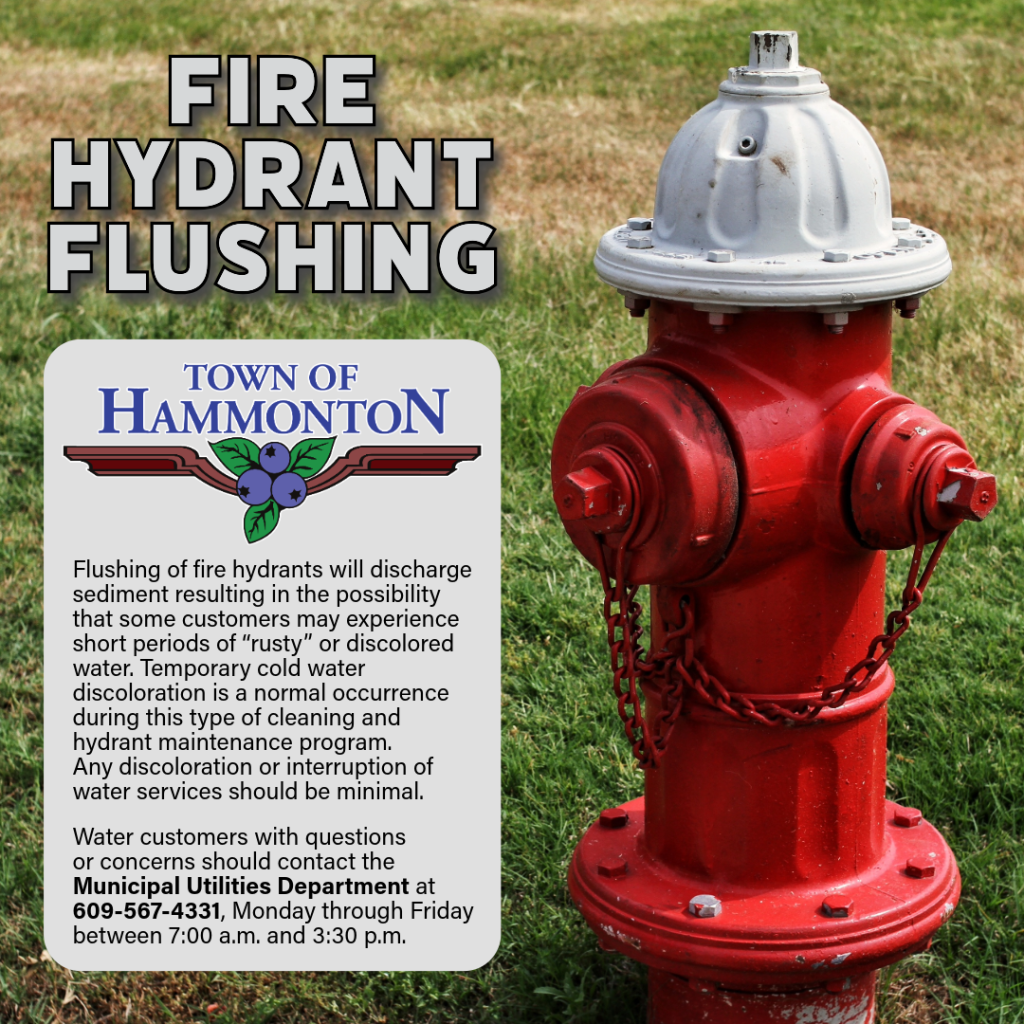
The Water Department cleans the water system by flushing fire hydrants in the spring and fall. The flushing of the system rids the water mains of any iron and foreign debris that might have deposited on the bottom of the water main. Hydrant flushing maintains the hydrant and keeps it in working order. It also helps us provide clean drinking. During these months, homeowners are urged to run their water directly after flushing to clean any debris that may remain in the water lines in their homes.
Excavating
Before excavating roadways call 1-800-272-1000 which ensures that appropriate mark outs are made.
Sewer Hookup
Application can be obtained from the Tax Collector office.
Hookup Fee: $2,000.00 (requires plumbing inspection)
In Case of Sewer Emergency after business hours, contact the Hammonton Police (609) 561-4000, option #1.
For questions regarding your sewer bill, contact the Tax Collector’s Office at 609-567-4300 Ex. 119.
Link: Public Notice about Drinking Water
Municipal Utilities Superintendent:
Anthony DeCicco
Email: adecicco@townofhammonton.org
Phone: 609-567-4331
Fax: 609-567-5368
Hours of Operation:
Monday – Friday
7:00 am to 3:30 pm
In case of an emergency or if you need assistance outside of regular business hours, please reach out to the Hammonton Police Department by calling 609-567-4300 Ext. 222.
Annual reports are designed to inform you about the quality of water and the services we deliver to you every day.
All our drinking water supply is ground water. We have five (5) active wells, which draw water from the Cohansey – Kirkwood Aquifer System.
We have two standing water storage towers with a combined storage capacity of 1.8 million gallons. We also have two underground storage facilities with a combined total of 100,000 gallons.
Click the year below to view and download:
